To wrap up Women's History (or "Her"story... you see what I did there?) Month, take a listen to this amazing song written by former SNLer Will Forte!

Showing posts with label women's history. Show all posts
Showing posts with label women's history. Show all posts
Friday, March 30, 2012

Thursday, March 29, 2012
Women's History Month: Elizabeth Cady Stanton
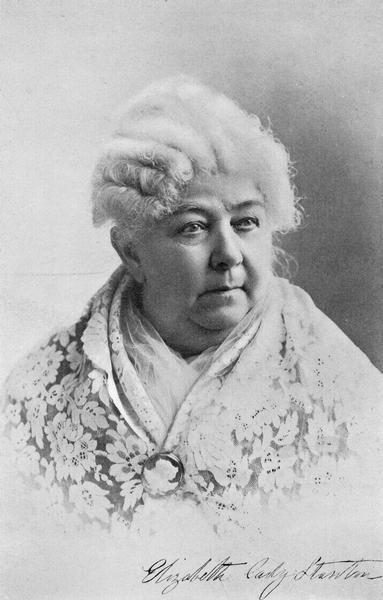 Elizabeth Cady Stanton was born on November 12, 1815, in Johnstown, New York.
Her father was an attorney, and so the young Elizabeth loved perusing through his law books. It was during this time that Elizabeth started to notice how the law unfairly favored men over women.
She was formally educated (unlike other girls of the time) at an Academy (or high school). She enjoyed co-ed classes and would intellectualize with the boys and win lots of academic awards.
Her father wasn't so encouraging though. When Elizabeth's older brother suddenly died, her father told her that he wished she had been born a boy. Elizabeth was heartbroken, but found encouragement from a next-door-neighbor, the Reverend Simon Hosak, who tutored her in the Greek language.
After graduating from the Academy, Elizabeth went on to continue her studies at Troy Female Seminary, where she got rightly freaked out by a fire-and-brimstone preacher. Then her father took her to Niagara Falls, which "restored her sense of balance." After that incident, she never returned to organized Christianity.
Elizabeth met her sexy husband (this, at 3:30), Henry Brewster Stanton, through her cousin. When they got married, she was all, "take that part out about obeying your husband! This is an equal partnership, and I'm not going to agree to that." They got busy and had seven children.
She loved being involved in social, political, and intellectual stimulation. She got to hang out with cool people like Frederick Douglass, Louisa May Alcott, and Ralph Waldo Emerson.
Henry was kind of a j-hole on the subject of women's rights. He didn't agree with Elizabeth's views and efforts for women's suffrage.
Something awesome about Elizabeth was that she was a proponent of "voluntary motherhood" -- meaning, not letting the husband demand sexy times from the submitting wife. My body, my choice! She was into homeopathy, and letting her children express themselves freely and have lots of outdoor adventures.
Elizabeth first got involved in the women's rights movement when, during her honeymoon, she attended an anti-slavery convention with her husband. She was forced to sit in a roped-off section with other women, out of the sight of the men. A cool dude named William Lloyd Garrison was all, "That's bull shit!" and sat with him. He's my new crush.

So, in 1848, she and some lady friends held the first women's rights convention, in Seneca Falls, where she declared men and women to be equal. Frederick Douglass was there and was all, "Holla!!!"

She met Susan B. Anthony in 1851. A beautiful friendship -- and partnership -- was formed, that lasted 50 years.
Once the 13th Amendment passed (allowing black men to vote), Stanton and Anthony got so pissed because their friends from the abolitionist movement wouldn't extend the vote to women as well.
Her radical positions included acceptance of interracial marriage, and the belief that organized Christianity relegated women to an unacceptable position in society. She was an strong supporter of birth control. Because of these views, many people chose to focus more on Anthony rather than Stanton when praising the women's rights movement. Until recently.
She died 18 years before women were granted the right to vote in the U.S. :(
Here's to you, Elizabeth!

Source: http://en.wikipedia.org/wiki/Elizabeth_Cady_Stanton
Wednesday, March 28, 2012
Women's History Month: Amelia Earhart
Amelia Mary Earheart was born in Atchison, Kansas on July 24, 1897.
 From an early age, Amelia, or "Meeley," as her family called her, acted as a ring leader to her younger sister, Grace, or "Pidge." Their upbringing was a little unconventional, since their mother didn't believe in raising her daughters to be "nice little girls." For example, Meeley and Pidge wore bloomers because they provided a little more freedom during playtime.
The two loved adventurously exploring their neighborhood. They climbed trees, hunted rats, and sledded down hills. They collected insects amphibians. Many biographers have pinned the young Amelia as a "tomboy" because of this love of outdoors and playfulness. A tell-tale sign of her future to come: she built a roller-coaster-like ramp on the side of her house and launched off of it, gaining some air and earning a bruised lip and torn dress.
Earhart graduated from Hyde Park High School in Chicago in 1916. Throughout her childhood, she continued to aspire to a future career, keeping a scrapbook of newspaper clippings about successful women in predominantly male-oriented fields, including film direction and production, law, advertising, management ,and mechanical engineering.
 During World War I, she received training as a nurse's aide and worked in a military hospital in Canada.
She later reunited with her parents in Southern California. In 1920 in Long Beach, Amelia received a ride in an airplane manned by air racer Frank Hawks... Amelia said of the experience, "By the time I had got two or three hundred feet off the ground, I knew I had to fly." Afterwards she worked countless odd-jobs to earn $1,000 for flight lessons. Her teacher was Anita "Neta" Snook, a pioneer female aviator.
Amelia bought a sweet-ass leather jacket and slept in it for three nights in order to give it a worn-in look, so the asshole-y male aviators wouldn't judge her. She also cut her hair super short in the style of other female flyers. She eventually bought a second-hand, bright-yellow plane she named "The Canary." In 1922, she flew it up to an altitude of 14,000 feet, setting a world record for female pilots. And in 1923 she became the 16th woman to receive a pilot's license. BOO YAH!

 After Charles Lindbergh's solo flight across the Atlantic in 1927, Amy Phipps Guest, expressed interest in being the first woman to fly (or be flown) across the Atlantic Ocean. After deciding the trip was too perilous for her to undertake, she offered to sponsor the project, suggesting they find "another girl with the right image." While at work one afternoon in 1928, Earhart got a phone call from Capt. Hilton H. Railey, who asked her, "Would you like to fly the Atlantic?" And she was all FUCK YAH! (just kidding).
It was 20 hour flight across the Atlantic. But technically she actually didn't fly it alone... or fly the plane at all. She was accompanied by two dudes who were sort of in charge of flying because Amelia had never worked with that kind of plane before. Still, she hoped to

 someday do it on her own.
After her transatlantic flight, she did a lot of celebrity endorsements to earn money to finance her flying career, and was even an associate editor for Cosmopolitan Magazine.
She performed her first long solo flight in August 1928, across the North American continent and back.
During a female aviator race in 1929, one of her BFFs crashed her plane at take-off. Amelia abandoned her own plane to make sure her friend was ok. After making sure she was uninjured, Amelia took off, but finished third in the race. The event was symbolic of Amelia's courageous selflessness.
In 1931, she set a world altitude record of 18,415 feet. Bad ass.

She married her publicist, GP Putnam, in 1931. They had become "intimate" earlier on, when Amelia was engaged to another man (Whoops!).

She had liberal views of marriage at the time, believing both husband and wife should be "breadwinners," and she did not take on his last name. The two had no children together.
In 1932, at age 34, Amelia flew solo across the Atlantic. She intended to land in Paris, but because of strong winds, she landed in North Ireland.
As the first woman to fly solo non-stop across the Atlantic, Earhart received the Distinguished Flying Cross from Congress, the Cross of Knight of the Legion of Honor from the French Government and the Gold Medal of the National Geographic Society from President Herbert Hoover.
On January 11, 1935, Earhart became the first person to fly solo from Honolulu, Hawaii to Oakland, California. In the final hours of the flight, she relaxed and listened to the broadcast of the New York Metropolitan Opera. Baller!

Early in 1936, Earhart started to plan a round-the-world flight. She wouldn't be the first to circle the globe, but it would be the longest flight, at 29,000 miles, following a grueling equatorial route.
The first attempt was on St. Patrick's Day, March 17, 1937. Earhart and her crew flew the first leg from Oakland, California to Honolulu, Hawaii. Due to lubrication and galling problems with the propeller hubs' variable pitch mechanisms, the aircraft needed servicing in Hawaii. Then, because of a faulty takeoff, the flight was called off and the aircraft was shipped by sea to California for repairs.
For the second attempt, she departed from Miami on June 1 and after numerous stops in South America, Africa, the Indian subcontinent, and Southeast Asia, she arrived at Lae, New Guinea, on June 29, 1937. At this stage about 22,000 miles of the journey had been completed. The remaining 7,000 miles would be over the Pacific.
But because of loss of communication, and problems with seeing the island they were supposed to land on next, the theory is that the plane ran out of fuel and was lost at sea. Many search efforts were made by the government and by Amelia's husband, but she was never found. Some say she was really on a spy mission and was captured by the Japanese. Others said it was suicide. I guess we'll never know. Or maybe we will eventually. I have no idea. All I know is she was an awesome lady.
Sources: http://www.biography.com/people/amelia-earhart-9283280?page=7
http://en.wikipedia.org/wiki/Amelia_Earhart
The first attempt was on St. Patrick's Day, March 17, 1937. Earhart and her crew flew the first leg from Oakland, California to Honolulu, Hawaii. Due to lubrication and galling problems with the propeller hubs' variable pitch mechanisms, the aircraft needed servicing in Hawaii. Then, because of a faulty takeoff, the flight was called off and the aircraft was shipped by sea to California for repairs.
For the second attempt, she departed from Miami on June 1 and after numerous stops in South America, Africa, the Indian subcontinent, and Southeast Asia, she arrived at Lae, New Guinea, on June 29, 1937. At this stage about 22,000 miles of the journey had been completed. The remaining 7,000 miles would be over the Pacific.
But because of loss of communication, and problems with seeing the island they were supposed to land on next, the theory is that the plane ran out of fuel and was lost at sea. Many search efforts were made by the government and by Amelia's husband, but she was never found. Some say she was really on a spy mission and was captured by the Japanese. Others said it was suicide. I guess we'll never know. Or maybe we will eventually. I have no idea. All I know is she was an awesome lady.

Sources: http://www.biography.com/people/amelia-earhart-9283280?page=7
http://en.wikipedia.org/wiki/Amelia_Earhart
Tuesday, March 27, 2012
Women's History Month: Carole King

Born Carol Klein (she added the "e" to her first name) in 1942 to a Jewish family, Carol King grew up in Brooklyn. She learned the piano, then began singing with a vocal quartet called the Co-Sines at James Madison High School. She attended Queens College, where she was a classmate (and girlfriend) of Neil Sedaka and inspired Sedaka's first hit, "Oh! Carol." She responded with "Oh! Neil." At Queens College, she befriended Paul Simon and Gerry Goffin. She later married Goffin and they had two daughters.
 Goffin and King formed a songwriting partnership for Aldon Music in New York. Their first success was "Will You Love Me Tomorrow," recorded by The Shirelles. It topped the American charts in 1961, becoming the first No. 1 hit by a girl group.
While dating Goffin in high school, King became pregnant at the age of 17. Upon coming to her parents with the news of her pregnancy, they decided it was best for King and Goffin to get married as soon as possible. They married in a Jewish ceremony on Long Island. King gave birth to Louise shortly afterwards and would eventually go on to have another child, Sherry.
Goffin and King's 1967 song, "Pleasant Valley Sunday," a No. 3 for The Monkees, was inspired by their move to suburban West Orange, New Jersey.
Goffin and King divorced in 1968 but Carole consulted Goffin on music she was writing. King lost touch with Goffin because of his declining mental health and the effect it had on their children.
King sang backup vocals on Little Eva's "The Loco-Motion" which she also co-wrote. She had had a modest hit in 1962 singing one of her own songs, "It Might As Well Rain Until September," but after that it took King eight years to reach the Hot 100 singles chart again as a performer.
 King followed her first solo album (a commercial disappointment) with Tapestry, featuring new folk-flavored compositions, as well as reinterpretations of two of her songs, "Will You Love Me Tomorrow" and "(You Make Me Feel Like) A Natural Woman." Tapestry was an instant success. With numerous hit singles – including a Billboard No.1 with "It's Too Late" – Tapestry held the no.1 spot for 15 consecutive weeks, remained on the charts for nearly six years, sold 10 million copies in the U.S., and 25 million worldwide. The album garnered four Grammy Awards including Song of the Year, King being the first woman to win the award ("You've Got a Friend").
In 1973, King performed a free concert in New York City's Central Park with 100,000 attending.
After relocating to Idaho in 1977, King became involved in environmental issues. Since 1990, she has been working with the Alliance for the Wild Rockies and other groups towards passage of the Northern Rockies Ecosystem Protection Act.
Source: http://en.wikipedia.org/wiki/Carole_King
Monday, March 26, 2012
Women's History Month: Michelle Obama

Michelle Obama was born January 17, 1964, in Chicago, Illinois. Michelle was raised on Chicago's South Side in a one-bedroom apartment. Her father, Frasier Robinson, was a city pump operator. Her mother, Marian, was a secretary who later stayed home to raise Michelle and her older brother, Craig. The family has been described as a close-knit one that shared family meals, read, and played games together.
Both children were raised with an emphasis on education. The brother and sister learned to read at home by the age of four, and both skipped second grade.
By sixth grade, Michelle was attending gifted classes, where she learned French and took accelerated courses. She then went on to attend the city's first magnet high school for gifted children where, among other activities, she served as the student government treasurer.
 She attended Princeton University, graduating cum laude in 1985 with a B.A. in Sociology. "I remember being shocked," she says, "by college students who drove BMWs. I didn't even know parents who drove BMWs." She went on to earn a J.D. from Harvard Law School in 1988.
Following law school, she worked at a Chicago law firm, where she met Barack Obama, a summer intern. "I went to Harvard and he went to Harvard, and the firm thought, 'Oh, we'll hook these two people up,'" Michelle says. "So, you know, there was a little intrigue, but I must say after about a month, Barack… asked me out, and I thought no way. This is completely tacky." She refused to date Obama, believing that their work relationship would make the romance improper. But eventually she relented, and their first date was to the Spike Lee movie Do the Right Thing. The couple soon fell in love and married in 1992.
Her early career includes being an Executive Director for the Chicago office of Public Allies, a non-profit leadership-training program that helped young adults develop skills for future careers; associate dean of student services at
the University of Chicago, where she developed the University’s first community service program; executive director of community relations and external affairs at the University of Chicago Hospitals; and vice president of community relations and external affairs at the University of Chicago Medical Center, where she continues to work part-time.
In 2007, she scaled back her own professional work to attend to family and campaign obligations during Barack's run for presidential nomination. Michelle says she's made a "commitment to be away overnight only once a week — to campaign only two days a week and be home by the end of the second day" for their two daughters, Malia (born 1999) and Natasha (2001). It has been reported that the Obama family has no nanny, and that the children are left with Michelle's mother while their parents campaign.
As the 44th First Lady of the United States, Michelle has focused her attention on issues such as the support of military families, helping working women balance career and family, and encouraging national service.
Michelle has supported the organic food movement, instructing the White House kitchens to prepare organic food for guests and her family. In March 2009, Michelle worked with 23 fifth graders from a local school in Washington, D.C., to plant a 1,100 square foot garden of fresh vegetables (the first White House vegetable garden since Eleanor Roosevelt served as First Lady) and install bee hives on the South Lawn of the White House. In 2010, Michelle put efforts to fight childhood obesity near the top of her agenda.
Sources: http://www.biography.com/people/michelle-obama-307592
http://en.wikipedia.org/wiki/Michelle_Obama
Friday, March 23, 2012
Women's History Month: Lucille Ball
 Lucille Ball was born to Henry Durrell Ball and Desiree "DeDe" Evelyn Hunt in Jamestown, New York.
Her grandfather, Fred Hunt, was an eccentric who also enjoyed the theater. He frequently took the family to vaudeville shows and encouraged young Lucy to take part in both her own and school plays.
Despite the family's meager finances, her mother arranged for a teenaged Lucille to go to the John Murray Anderson School for the Dramatic Arts in New York City where Bette Davis was a fellow student. She later said about that time in her life "All I learned in drama school was how to be frightened."
After an uncredited stint as one of the Goldwyn Girls in Roman Scandals (1933) Lucille permanently moved to Hollywood to appear in films. She appeared in many small movie roles in the 1930s as a contract player for RKO Radio Pictures, including a two-reel comedy short with the Three Stooges and a movie with the Marx Brothers.
Lucille soon became known in many Hollywood circles as "Queen of the B's" – a title previously held by Fay Wray – starring in a number of B-movies.
In 1940, she met Cuban-born bandleader Desi Arnaz while filming the Rodgers and Hart stage hit Too Many Girls. When they met again on the second day, the two connected immediately and eloped the same year.
In 1942 Lucille appeared in DuBarry Was a Lady, a film for which the natural brunette first had her hair dyed the flaming red that would be her screen trademark.
In 1948, she was cast as a wacky wife in a radio program for CBS Radio. The program was successful, and CBS asked Lucille to develop it for television. She agreed, but insisted on working with Arnaz. CBS executives were reluctant, thinking the public would not accept an all-American redhead and a Cuban as a couple. The couple toured the road in a vaudeville act with Lucille as the zany housewife wanting to get in Arnaz's show. The tour was a smash, and CBS put I Love Lucy on their lineup.

Lucille was the first woman in television to be head of a production company: Desilu, the company that she and Arnaz formed.
I Love Lucy has virtually never gone out of syndication since it began, seen by hundreds of millions of people around the world over the past half century.
It dominated the weekly TV ratings in the U.S. for most of its run. In the scene where Lucy and Ricky are practicing the tango in the episode "Lucy Does The Tango," the longest recorded studio audience laugh in the history of the show was produced.
When Lucille registered to vote in 1936, she listed her party affiliation as Communist. In 1953, during the Red Scare, she had to meet with the House Committee of Un-American Activities, stating that she "at no time intended to vote as a Communist." J. Edgar Hoover named "Lucy and Dezi" among his "favorites of the entertainment world." Immediately before the filming of episode 68 of I Love Lucy, Arnaz, instead of his usual audience warm-up, told the audience, "The only thing red about Lucy is her hair, and even that's not legitimate.
On July 17, 1951, one month before her 40th birthday and after "several" miscarriages, Lucille gave birth to her first child, Lucie Désirée Arnaz. A year and a half later, she gave birth to her second child, Desi Arnaz, Jr.
On May 4, 1960, just two months after filming the final episode of The Lucy-Desi Comedy Hour, the couple divorced. Until his death in 1986, however, Desi and Lucille remained friends and often spoke very fondly of each other.
In her later career, she made a few more movies including Yours, Mine, and Ours (1968), the musical Mame (1974), and two more successful sitcoms: The Lucy Show which costarred Vivian Vance, and Here's Lucy which featured Lucy's real life children.
Because of her liberated mindset and approval of the women's movement, Lucille Ball was inducted into the National Women's Hall of Fame.
Thursday, March 22, 2012
Women's History Month: Julia Child

Here's to JULIA CHILD!
She was born Julia Carolyn McWilliams in Pasadena, California.
At six feet, two inches tall, Julia played tennis, golf, and basketball as a child and continued to play sports while attending Smith College, from which she graduated in 1934 with a major in English.
Following her graduation from college, she moved to New York City, where she worked as a copywriter. Returning to California in 1937, Julia spent the next four years writing for local publications.
She joined the Office of Strategic Services (OSS) after finding that she was too tall to enlist in the Women's Army Corps or in the U.S. Navy's WAVES. She worked at the OSS Emergency Rescue Equipment Section (ERES) as an assistant to developers of a shark repellent needed to ensure that sharks would not explode ordnance targeting German U-boats. In 1944 Julia was posted to Kandy, Ceylon (now Sri Lanka). She was later posted to China, where she received the Emblem of Meritorious Civilian Service as head of the Registry of the OSS Secretariat.

While in Ceylon, Julia met Paul Child, also an OSS employee, and the two were married September 1, 1946. Paul had lived in Paris as an artist and poet, was known for his sophisticated palate, and introduced his wife to fine cuisine. He joined the United States Foreign Service and in 1948 the couple moved to Paris when the US State Department assigned Paul there.
Julia repeatedly recalled her first meal in Rouen, France as a culinary revelation; once, she described the meal of oysters, sole meunière, and fine wine as "an opening up of the soul and spirit for me." In Paris she attended the famous Le Cordon Bleu cooking school and later studied privately with master chefs. Julia joined the women's cooking club "Cercle des Gourmettes," through which she met Simone Beck, who was writing a French cookbook for Americans with her friend Louisette Bertholle. Beck proposed that Julia work with them, to make the book appeal to Americans.
In 1951, Julia, Beck, and Bertholle began to teach cooking to American women in Child's Paris kitchen, calling their informal school "L'école des trois gourmandes" (The School of the Three Food Lovers). For the next decade, the three researched and repeatedly tested recipes. jULIA translated the French into English, making the recipes detailed, interesting, and practical.
Their book was first published in 1961: a 734-pager titled Mastering the Art of French Cooking. It was a best-seller and received critical acclaim that derived in part from the American interest in French culture in the early 1960s. Lauded for its helpful illustrations and precise attention to detail, and for making fine cuisine accessible, the book is still in print and is considered a seminal culinary work.
Her first television show, The French Chef, premiered in 1963. She attracted the broadest audience with her cheery enthusiasm, distinctively charming warbly voice, and non-patronizing and unaffected manner.
In the 1970s and 1980s, she was the star of numerous television programs.
Julia 's kitchen, designed by her husband, was the setting for three of her television shows. It is now on display at the National Museum of American History in Washington, D.C.
In 2000, Julia received the French Legion of Honor and was elected a Fellow of the American Academy of Arts and Sciences in 2000.
Wednesday, March 21, 2012
Women's History Month: Georgia O'Keeffe
 Georgia O'Keeffe was born November 15, 1887, in a farmhouse near Sun Prairie, Wisconsin. Her parents were dairy farmers.
She decided at an early age that she wanted to be an artist, and was lucky enough to receive art lessons from a local watercolor artist named Sara Mann.
After graduating high school Georgia went to the Art Institute of Chicago for a few years, and then the Art Students League in New York City. There, she studied under an American impressionist painter named William Merritt Chase (he ended up establishing Parsons The New School for Design). Georgia did well there, winning a prestigious scholarship to go study at an outdoor summer school in Lake George, New York. Also while in New York City, she was able to see a Rodin exhibition at a gallery owned by her future husband.
Soon Georgia lost faith in herself becoming a successful fine artist, so she started doing commercial work in Chicago. She took a four-year break from painting, until she attended a summer school at the University of Virginia. There, Georgia was introduced to the revolutionary and expressive ideas of painter Arthur Wesley Dow, an inspiration for her future work. After her time there, she taught art in a public school in Texas, and continued teaching at various places for quite awhile.
Georgia's first gallery show was in 1917. Her friend, photographer Anita Pollitzer, had sent some of her charcoal works to a New York gallery behind her back -- the gallery where the Rodin exhibition had been, owned by a man named Alfred Stieglitz. He loved Georgia's work and put it up immediately. Georgia was surprised to find this out.
Alfred and Georgia fell in love; Georgia moved to New York and took up painting full-time. They even moved in together. But, there was scandal: Alfred was 23 years older than her AND married. Yeesh. But he eventually got divorced and the two married.
Alfred was a photographer and loved taking pictures of Georgia. He took more than 350 of her... some of them erotic and nude, which was a bit scandalous for the time.
Georgia worked in oil and watercolor. She perfected the art of large scale paintings of natural objects seen at a close range, as if zoomed in on a particular detail. This is called Precisionism.
Critics took on a Freudian view of these paintings, believing that specifically the close up of centers of flowers represented female genitalia, which Georgia denied. Nevertheless, later feminist artists commended Georgia as the originator of "female iconography." Georgia did not agree with this, and was kind of pissed about their hullabaloo, thinking that it sounded like what male critics had written about her work. They were overlooking the larger issue: "her paintings reveal vital parallels between animate and highly sensual forces in nature and humans."
Georgia was super successful during her career, earning good money and important recognition in the American art world.
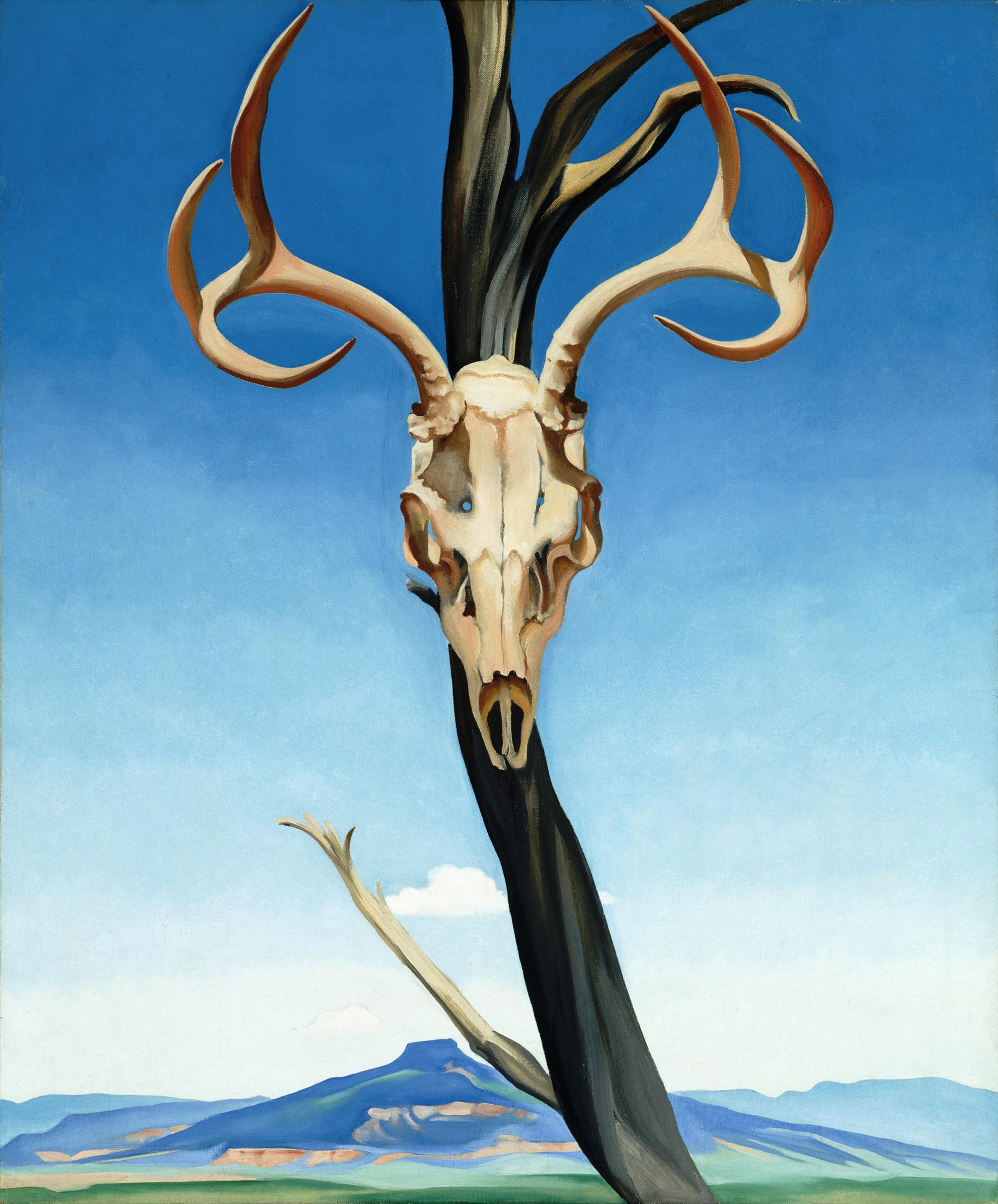
She loved painting in New Mexico; she would hike and camp in the terrain and collect rocks and bones from the desert landscape.
In 1932, Georgia had a nervous breakdown because she was not able to finish a commissioned mural for the Radio City Music Hall. She recuperated in Bermuda.She returned to New Mexico in the summer of 1934. In August of that year, she visited Ghost Ranch, north of Abiquiu, for the first time and decided immediately to live there; in 1940, she purchased a house on the ranch property. The varicolored cliffs of Ghost Ranch inspired some of her most famous landscapes. Among guests to visit her at the ranch over the years were Charles and Anne Lindbergh, singer-songwriter Joni Mitchell, poet Allen Ginsberg, and photographer Ansel Adams.
Known as a loner, Georgia explored the land she loved often in her Ford Model A, which she purchased and learned to drive in 1929.
In 1946, the Museum of Modern Art (MOMA) in Manhattan held a retrospective for her, the first retrospective MOMA held for a woman artist.
In 1972, Georgia's eyesight was compromised by macular degeneration, leading to the loss of central vision and leaving her with only peripheral vision. She stopped oil painting without assistance in 1972, but continued working in pencil and charcoal until 1984.
She died on March 6, 1986, at the age of 98.
Source: en.wikipedia.org/wiki/Georgia_O'Keeffe
Tuesday, March 20, 2012
Women's History Month: First Lady Lou Hoover

{Lou Hoover working with Girl Scouts in the field}
Here's to Lou Hoover, wife of President of the United States Herbert Hoover and First Lady of the United States, 1929-1933.
Lou grew up something of a tomboy in Waterloo, Whittier, California and Monterey, California. Her father took her on camping trips in the hills—her greatest pleasures in her early teens. Lou became a fine horsewoman; she hunted, and preserved specimens with the skill of a taxidermist; she developed an enthusiasm for rocks, minerals, and mining. In 1894, Lou enrolled at Stanford University as the school's only femal
e geology major. That year she met Herbert Hoover, then a senior.
Lou continued her education and Herbert pursued his engineering career in Australia. From there in 1898, the year she graduated from Stanford, Herbert cabled a marriage proposal, which she promptly accepted by return wire.
Both Herbert and Lou were 24 when they married in 1899, at the home of the bride's parents in Monterey, California. The next day they sailed from San Francisco for Shanghai, China. The newlyweds soon settled into their first home, a large house in Tianjin. Herbert's job required extensive travel throughout remote, primitive and dangerous areas, which they did together. Mrs. Hoover was present with her husband during the Boxer Rebellion. Possessed of a natural ear for languages, she became quite proficient in Chinese. In the White House, at times, the Hoovers would converse in Chinese to foil eavesdroppers. To date, she is the only First Lady to speak an Asian language.
 Lou also distinguished herself by becoming the first First Lady to broadcast on a regular basis. While she did not have her own radio program, she was a guest speaker on a number of occasions from 1929 through 1933, often advocating for volunteerism, or discussing the work of the Girl Scouts. Radio critics praised Lou for having an excellent radio voice and for speaking with confidence.
During World War I, she assisted her husband in providing relief for Belgian refugees. For her work, Lou was decorated in 1919 by King Albert I of Belgium. While Herbert served in the cabinet of Presidents Harding and Coolidge, she was active as national president of the Girl Scouts of the USA.
Lou was a remarkable First Lady. She challenged existing social mores by lobbying for more women in government positions and by rebuffing southern racial customs. Lou's behind-the-scenes efforts on behalf of charities exemplified the Hoover administration’s anti-Depression efforts and demonstrated her compassion.
Sources: en.wikipedia.org/wiki/Lou_Henry_Hoover
millercenter.org/president/hoover/essays/firstlady
Monday, March 19, 2012
Women's History Month: Dorothy Dandridge
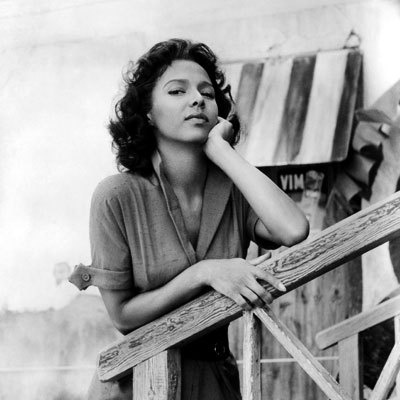 Here's to pioneering African American film star and performer Dorothy Dandridge.
Dorothy's mother, Ruby Dandridge created an act for her two young daughters, Vivian and Dorothy, under the name of "The Wonder Children." The daughters toured the Southern United States for five years. During this time, they toured almost non-stop and rarely attended school.
At the onset of the Great Depression, work virtually dried up for the Dandridges. "The Wonder Kids" were renamed "The Dandridge Sisters" and booked into such venues as the Cotton Club and the Apollo Theater in Harlem, New York City.
Dorothy first gained fame as a solo artist from her performances in nightclubs.
Her first screen appearance was a bit part in an Our Gang comedy in 1935. In 1937, Dorothy appeared as one of the many singers in the Marx Brothers' feature film A Day at the Races. She played a murderer in the race film Four Shall Die — her first credited film role. Though the part was a supporting role and the film was somewhat of a success, Dorothy struggled to find good film roles.
The following year, she was cast opposite John Wayne in Lady From Louisiana (1941), playing the small part. That same year Dorothy teamed with her future husband Harold Nicholas in Sun Valley Serenade.
She married Nicholas in 1942, and gave birth to her only child, Harolyn Suzanne Nicholas, in 1943. Harolyn was born brain-damaged, and the couple divorced in 1951.
In 1951, Dorothy was cast as Melmendi, Queen of the Ashuba, in Tarzan's Peril. Her role was somewhat minor, but she would be noticed by many. One night while at a party, Dorothy was introduced to music manager Earl Mills. Mills had agreed to get her a career started as a singer, but Dorothy preferred to focus on the motion picture industry. Despite this disagreement, she signed Mills as her agent.

In 1954, Dorothy signed a three movie deal with 20th Century Fox. Soon after, director and writer Otto Preminger cast her along with Harry Belafonte and Pearl Bailey in an all-black production of Carmen Jones. However, Dorothy's singing voice was dubbed by opera singer.
The film received favorable reviews, and she was nominated for an Academy Award for Best Actress, becoming only the third African American to receive a nomination in any Academy Award category but the first African-American to be nominated for best actress.
In 1955, 20th Century Fox selected Dorothy to play the supporting role of Tuptim in the film version of the Broadway hit The King and I, starring Deborah Kerr and Yul Brynner. The character was a slave, which made her decline the offer.
In 1959, Columbia Pictures cast Dorothy in the lead role of Bess in Porgy and Bess; she was again nominated for an award, this time for a Golden Globe Award for Best Actress. Dorothy lost, this time to Marilyn Monroe in Some Like It Hot.
Despite positive reviews, Porgy and Bess was a box office failure. The film's characters were described by several African-Americans as "stereotypical": Bess was a drug addict, Porgy a crippled drunk. Many believed these characters pandered to stereotypes about African-Americans, adding to its controversy.
The actor who got the most blame for the failure of Porgy and Bess was Dorothy. Before the film, many other African-American actresses and actors looked up to her as someone who had proved that an African-American woman could achieve what a white woman or man could. But many thought Dorothy was "selling out" when she accepted the role of Bess.
A few weeks after the box-office disappointment of Porgy and Bess, she was released from her 20th Century Fox contract.
Dorothy married Jack Denison in 1959, although the pair divorced amid allegations of domestic violence and financial setbacks. At this time, she discovered that the people who were handling her finances had swindled her out of $150,000, and that she was $139,000 in debt for back taxes. Dorothy was forced to sell her Hollywood home and to place her daughter in a state mental institution.
On September 8, 1965, Dorothy was found dead by her manager in her home. Los Angeles pathology institute determined the cause to be an accidental overdose of Imipramine, a tricyclic antidepressant. She was 42 years old.
Many years passed before the entertainment industry acknowledged Dorothy's legacy and contributions to the role of African-Americans in film. She was given a star on the Hollywood Walk of Fame for her impact on the motion picture industry.
Friday, March 16, 2012
Women's History Month: Nora Ephron
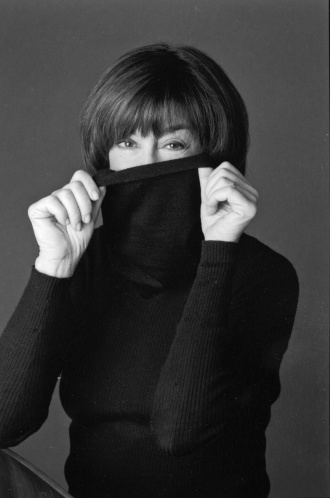 Here's to screenwriter, director, and journalist Nora Ephron.
"I try to write parts for women that are as complicated and interesting as women actually are."
Nora was born in New York City, eldest of four daughters in a Jewish family, and grew up in Beverly Hills; her parents, Henry and Phoebe Ephron, were screenwriters who wrote classics such as There's No Business Like Show Business and Desk Set. Her parents based Sandra Dee's character in the play and the Jimmy Stewart film Take Her, She's Mine on their 22-year-old daughter Nora and her letters to them from college. She graduated from Beverly Hills High School in 1958, and from Wellesley College in 1962.
Nora has been married three times. Her second was to journalist Carl Bernstein of Watergate fame in 1976. She had an infant son, Jacob, and was pregnant with her second son, Max, in 1979 when she found out the news of Bernstein's affair with their mutual friend, married British politician Margaret Jay. Nora was inspired by the events to write the 1983 novel Heartburn, which was made into a 1986 film starring Jack Nicholson and Meryl Streep. In the book, she wrote of a husband named Mark, who was “capable of having sex with a Venetian blind.” Nora also said that the character Thelma (based on Margaret Jay) looked like a giraffe with "big feet." Bernstein threatened to sue over the book and film, but he never did.
She worked briefly as an intern in the White House of President John F. Kennedy.
Nora landed a job at the New York Post, where she stayed as a reporter for five years. Upon becoming a successful writer, she wrote a column on women's issues for Esquire. In this position, Nora made a name for herself by taking on subjects as wide-ranging as Dorothy Schiff, her former boss and owner of the Post; Betty Friedan, whom she chastised for pursuing a feud with Gloria Steinem; and her alma mater Wellesley, which she said had turned out a generation of "docile" women.
For many years, she was among only a handful of people in the world claiming to know the identity of Deep Throat, the source for news articles written by her husband Carl Bernstein during the Watergate scandal.
She has received Academy Award nominations for Best Original Screenplay for When Harry Met Sally, Silkwood, and Sleepless in Seattle, which she also directed. Other film successes include You've Got Mail and Julia & Julia.
Sources: http://en.wikipedia.org/wiki/Nora_Ephron
http://www.huffingtonpost.com/nora-ephron
http://iml.jou.ufl.edu/projects/fall99/kirkman/ephronbio.htm
Thursday, March 15, 2012
Women's History Month: Joan Baez
 Here's to folksinger and activist Joan Baez.
Her family converted to Quakerism during Joan's early childhood, and she has continued to identify with the tradition, particularly in her commitment to pacifism and social issues.
When she was a child, a friend of her father gave her a ukulele. Joan learned four chords, which enabled her to play rhythm and blues, the music she was listening to at the time. Her parents, however, were fearful that the music would lead her into a life of drug addiction.
In 1957, at age 16, Joan committed her first act of civil disobedience by refusing to leave her Palo Alto High School classroom for an air-raid drill. After the bells rang, students were to leave the school, make their way to their home air-raid shelters, and pretend they were surviving an atomic blast. Protesting what she believed to be misleading government propaganda, Joan refused to leave her seat when instructed and continued reading a book. For this act she was punished by school officials, and was ostracized by the local population for being a supposed "Communist infiltrator."
In 1958, Joan's father accepted a faculty position at MIT, and moved his family to Massachusetts. At that time, it was within the center of the up-and-coming folk-music scene, and she began busking near home in Boston and nearby Cambridge.
Joan and two other folk enthusiasts recorded an album in the cellar of a friend's house. The three sang solos and duets, a family friend designed the album cover, and it was released on Veritas Records as Folksingers 'Round Harvard Square.
Her true professional career began at that 1959 Newport Folk Festival; following that appearance, she recorded her first album for Vanguard Records, Joan Baez (1960). The collection of traditional folk ballads, blues, and laments sung to her own guitar accompaniment sold moderately well.
Joan's second release, Joan Baez, Vol. 2 (1961) went "gold," as did Joan Baez in Concert, Part 1 (1962) and Joan Baez in Concert, Part 2 (1963). From the early-to-mid-1960s, she emerged at the forefront of the American roots revival, where she introduced her audiences to the then-unknown Bob Dylan (the two became romantically involved in late 1962, remaining together through early 1965).

Joan was one of the first musicians to use her popularity as a vehicle for social protest, singing and marching for human rights and peace. The early years of her career saw the civil-rights movement in the U.S. become a prominent issue. Joan's performance of "We Shall Overcome", the civil-rights anthem, at Martin Luther King's 1963 March on Washington for Jobs and Freedom permanently linked her to the song.
In 1966, she stood in the fields alongside César Chávez and California's migrant farm workers as they fought for fair wages and safe working conditions, and performed at a benefit on behalf of the United Farm Workers union that year.
In 1964, Joan founded the Institute for the Study of Nonviolence and encouraged draft resistance at her concerts.
She was arrested twice in 1967 for blocking the entrance of the Armed Forces Induction Center in Oakland, California and spent over a month in jail.
In 1969, Joan's appearance at Woodstock in upstate New York afforded her an international musical and political podium.
During Christmas of 1972, she joined a peace delegation traveling to North Vietnam, both to address human rights in the region, and to deliver Christmas mail to American prisoners of war. During Joan's time there, she was caught in the U.S. military's "Christmas bombing" of Hanoi, North Vietnam, during which the city was bombed for 11 straight days.
In 1978, she performed at several benefit concerts to defeat the Briggs Initiative, which proposed banning all gay people from teaching in the public schools of California. Later that same year, Joan participated in memorial marches for the assassinated San Francisco city supervisor Harvey Milk, who was openly gay.
She dated Apple Computer co-founder Steve Jobs during the early 1980s.
Joan continues to be socially and politically active, recently performing for the protesters and Occupy Wall Street.
Source: http://en.wikipedia.org/wiki/Joan_Baez
Wednesday, March 14, 2012
Women's History Month: Dorothea Lange
 Here's to Dorothea Lange, influential American documentary photographer and photojournalist.
Lange contracted polio at age seven which left her with a weakened right leg and a permanent limp."It formed me, guided me, instructed me, helped me and humiliated me," she once said of her altered gait. "I've never gotten over it, and I am aware of the force and power of it."
Lange was educated in photography at Columbia University in New York City.
With the onset of the Great Depression, she turned her camera lens to the street. Lange's studies of unemployed and homeless people captured the attention of local photographers and led to her employment with the federal Resettlement Administration (RA), later called the Farm Security Administration (FSA).
Her second husband Paul Schuster Taylor, a professor of economics at Cal Berkeley, educated Lange in social and political matters, and together they documented rural poverty and the exploitation of sharecroppers and migrant laborers for the next five years — Taylor interviewing and gathering economic data, Lange taking photos. Distributed free to newspapers across the country, her poignant images became icons of the era.
Her most famous photograph from her documentation of the Great Depression was "Migrant Mother."
In 1941, Lange was awarded a Guggenheim Fellowship for excellence in photography. After the attack on Pearl Harbor, she gave up the prestigious award to record the forced evacuation of Japanese Americans to relocation camps, on assignment for the War Relocation Authority. Lange covered the rounding-up of Japanese Americans and their internment in relocation camps. Her images were so obviously critical that the Army impounded them.

In 1945, Lange was invited by Ansel Adams to accept a position as faculty at the first fine art photography department at the California School of Fine Arts.
The true impact of her work was not felt until 1972, when the Whitney Museum incorporated 27 of her photographs into "Executive Order 9066," an exhibit about the Japanese internment. New York Times critic A.D. Coleman called Lange's photographs "documents of such a high order that they convey the feelings of the victims as well as the facts of the crime."
Sources: http://www.loc.gov/exhibits/wcf/wcf0013.html
http://en.wikipedia.org/wiki/Dorothea_Lange
Subscribe to:
Posts
(
Atom
)